

Security testing that tells you which findings are real.
ZeroQuarry tests your product continuously, then tries to disprove every finding before it reaches you. What survives arrives with a reproduction and a suggested fix.
The moments when security lands on your desk.
Six situations every software team knows. Each one maps to a ZeroQuarry workflow with an owner and an outcome.
Open-source report queue
A scanner files a confident CVE request. You have an afternoon to work out whether it is real.
See the workflowEnterprise deal
A buyer's security team wants current test evidence and your finding history by Friday.
See the workflowRisky release
One change touches tenant isolation, billing, uploads, and webhooks. It ships Thursday.
See the workflowResearcher report
An external claim lands in your inbox. Someone has to scope it, reproduce it, and answer.
See the workflowFast-moving codebase
Review has to keep pace with the pull requests without becoming a gate people route around.
See the workflowLean security team
You need real coverage across your products before the first AppSec hire lands.
See the workflowSeven capabilities. One loop.
Each one is a step in the same workflow, and every step writes to the same record. Start with whichever one is causing the most trouble.
AI security testing
Run AI penetration testing and application security reviews across source code, shipped binaries, and authorized live targets in one project history.
Explore capabilityAdversarial validation
Challenge AI security findings with skeptical vendor-style review, rebuttal, confidence scoring, evidence, and accountable human decisions.
Explore capabilityContinuous application security
Run continuous application security with PR scans, GitHub Actions, scheduled rescans, changed-code analysis, APIs, Slack, and scan lineage.
Explore capabilityAI security operations
Automate lean security operations with vulnerability-report intake, finding lifecycle, Jira, ServiceNow, GitHub, Slack, search, and audit history.
Explore capabilityVulnerability remediation
Move validated vulnerabilities into patches, GitHub auto-fix pull requests, Jira, ServiceNow, GitHub Issues, and focused security retests.
Explore capabilityPrivate execution
Run AI security scans from customer-controlled Docker runners for private Git repositories and authorized internal applications, with outbound-only connectivity and minimized result return.
Explore capabilitySecurity evidence and reporting
Create penetration test PDF reports, asset evidence packs, controlled finding shares, disclosure records, and audit trails for customers and auditors.
Explore capabilityFinding something is easy. Proving it is the hard part.
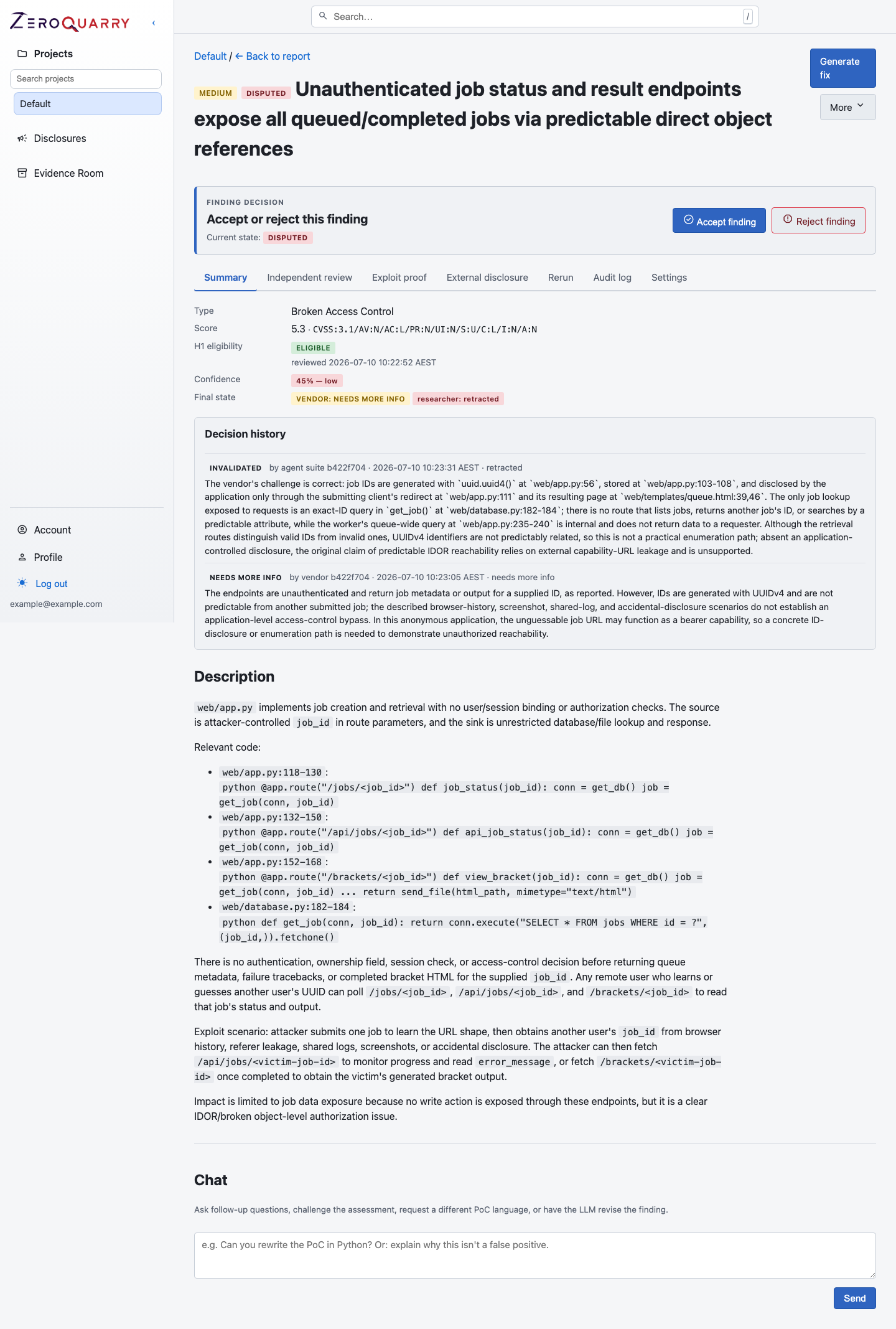
Automated scanners are fast and confident, and often wrong. ZeroQuarry runs a second pass that tries to break each finding, the way a vendor's security team would. If a finding cannot be reproduced, it is dropped rather than handed to your engineers.
A finding can be serious and still be wrong. We score severity and confidence separately, and show you the evidence for both.
When you dismiss a finding, the reason stays attached. Six months later, an auditor can see why.
Fixes arrive as pull requests under your own review, CI, and merge rules. Nothing merges itself.
Built where real vulnerability reports land.
ZeroQuarry is built by someone who spent fifteen years deciding what to do with vulnerability reports, including which ones earned a CVE, and who ran SOC 2 audits and published coordinated RCE research. The product comes out of that work rather than a scanner's rule set.
Published coordinated research on exploitable plugin and extension ecosystems.
Security leadership and vulnerability triage at Elastic, Kong, and Vectara.
What we learn from published research goes back into the product.
Trace the plugin path, prove reachability, and identify the affected configuration.
Test default state, permissions, versions, and realistic user action.
Coordinate the maintainer response before turning the finding into public research.
See what ZeroQuarry finds on your product.
Run the 30-day trial on one private product: real assessments, challenged findings, verified fixes, no card required.